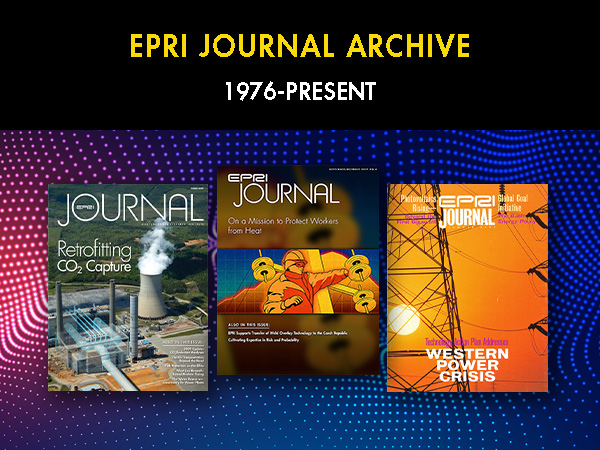


EPRI had a very clear mission when it was founded in 1972. Launched in response to a 1965 blackout that left around 30 million people in eight Northeastern states and two Canadian provinces without power, the formation of EPRI was an acknowledgment both of the vital importance of electricity and the critical need for independent, science-based research and development (R&D) to support its safe and reliable generation and delivery.
Although the world and the electric power industry have changed dramatically since then, EPRI’s mission persists to this day. So, too, has the understanding that achieving EPRI’s mission is not only about conducting world-class R&D; it’s also about communicating the findings of that research with the clarity necessary for utility engineers, decision makers, regulators, policymakers, and the public to understand and apply them.
A New Publication
That understanding was behind the February 1976 release of the first issue of EPRI Journal. EPRI’s founder and first president, Chauncey Starr, introduced the first issue by laying out four core objectives for the Journal: to communicate EPRI research findings; provide useful information for utility engineers; present a monthly update on research activities; and share regular updates on EPRI’s program plans, budgets, and relationships with government agencies.
Starr’s introduction placed the Journal within EPRI’s broader communications efforts, grounded from the start in the Institute’s technical reports. But that first issue was more than a mere administrative announcement. It also offered a tangible preview of the editorial ambition and approach the Journal would embrace for the next fifty years. For example, from the very beginning, the Journal has taken a long-term view of the forces and technologies shaping the utility and larger energy industry as well as society.
Imagining the Future, Staying Grounded in the Present
Indeed, the publication’s first feature article, “Solar Realities,” envisioned a late-21st-century future “powered directly and totally by the energy of the sun.” This was long before utility-scale solar projects became the mainstream generation assets they are today, a time when EPRI research focused on solar-assisted building heating and cooling as the most viable near-term option because producing electricity from sunlight was still impossibly expensive.
That first issue also had articles aimed at providing more immediately valuable insights to utility professionals and the industry. One piece examined the challenge posed by circuit breaker failures due to the growing prevalence of fault currents. At the same time, another explored a novel approach to identifying flaws in nuclear reactor vessels. The tone of the Journal‘s subsequent half-century has mirrored that inaugural issue, with coverage balanced between practical, relevant information of use in the moment and the identification of emerging technologies and trends likely to shape the industry decades in the future.
Decades of History
It is a dramatic understatement to say that the Journal has had plenty to cover over the decades of its existence. Indeed, the grid of the 1970s is almost unrecognizable from today’s power system. In the early years of the Journal, coal was the primary generation source and would remain so for many decades, but was supplemented by oil-fired power plants, hydropower, and nuclear power, which began an era of rapid expansion.
The Journal covered the rapid ascent of nuclear power in real time. A story from 1978, “The Birth and Early History of Nuclear Power,” described the many twists and turns of nuclear power, going from being dismissed as “moonshine” to supplying 12 percent of America’s electricity. The focus on nuclear was unsurprising, as utilities and the nation sought to reduce the risks of continued dependence on imported oil by accelerating research and deployment of both nuclear and coal technologies. After the 1979 Three Mile Island accident, the Journal devoted an entire issue to nuclear safety, including in-depth articles about what had actually happened to cause the accident, the response by industry and government, the impact of the event, and what could be learned about the design and operation of plants to make them all safer.
While headline-grabbing events like Three Mile Island inevitably garnered extensive coverage, the Journal continued to write about more slow-moving forces reshaping the industry through the 1980s, 1990s, 2000s, and beyond. While research into established and emerging technologies was a constant, the Journal also strove to educate readers about important market conditions. In the 1990s, for instance, deregulation reshaped electricity markets, and a 1994 cover story guided navigating the tectonic change. “Increasingly, the key to success in this more competitive environment is anticipating and actively responding to the forces that are shaping the new markets for electric power,” the story declared.
As the industry and the world around it continued to change quickly, the Journal strove to keep pace, albeit with the unique benefit of having identified and studied trends decades before they became pressing current topics. For example, the 2000s and 2010s saw the emergence of natural gas as a major power generation source, the rapid growth of renewable energy sources such as wind and solar, efforts and mandates to decarbonize, and the acceleration of electric vehicle (EV) purchases.
These and many other topics that appeared novel to other publications were covered in the Journal with a depth and legacy of knowledge made possible only because it reflected EPRI’s unparalleled research agenda. Solar energy, after all, had been the topic of the Journal‘s inaugural feature article, and what seem today like prescient looks into a future characterized by EVs, geothermal, advanced nuclear reactors, and other technologies were regular mainstays of the publication.
Looking Ahead
That same long-term, independent research perspective still defines the Journal today, and it may matter more now than ever. It helps make sense of a power system growing more distributed, digitized, and renewable. It also grounds coverage of the complex current moment, defined by load growth driven by data centers and electrification, and electricity’s increasingly central role in economies and societies worldwide.
Much has changed since Starr introduced the Journal 50 years ago. But much of his original mission remains in the publication’s vision moving forward. New technologies, policies, and market conditions will inevitably emerge. The Journal will continue to cover them, drawing on EPRI’s research and long-term perspective. At the same time, the Journal will stay focused on the topics, challenges, and opportunities that matter most today, whether that’s how flexible loads can help meet electricity demand or how to get the most out of the growing number of batteries deployed across the grid.
From Print to Digital
The Journal has also evolved with the technologies used to publish and distribute it, moving from print to dedicated digital platforms and, ultimately, to the open web. In 1976, print offered a fixed, one-way experience shaped by production schedules, physical layouts, and material costs. Later, mobile apps created more personalized, focused reading environments, while websites enabled quick story updates, multimedia integration, and global reach. Today’s web-first model gives the Journal greater flexibility to deliver timely, accessible, and engaging coverage wherever readers are. A new platform and upgrade to EPRI Journal are planned in 2027.
The other important constant in the Journal‘s future is you, our readers. To both longtime and new readers, thank you. You should know that the original vision to provide information that helps you do your jobs and understand the industry better will remain a cornerstone. But we also welcome your input about what would make the Journal an even more valuable resource as we head into the next half-century. It has been a fascinating and unpredictable journey so far. We hope you’ll stay with us for the next leg.