


What Fleet Managers Need to Know
As electric vehicles (EVs) become an increasingly common part of commercial and utility fleets, questions around fire safety arise. While available data indicate that fires involving electric vehicles may occur less frequently than those involving internal combustion engine (ICE) vehicles, EVs present unique hazards—particularly when a fire involves the high voltage traction battery or occurs while a vehicle is connected to charging equipment.
This white paper examines these risks with a specific focus on fleet environments, where many vehicles may be parked, charged, or stored together. It outlines practical considerations and emerging best practices that can help fleet managers reduce risk, improve preparedness, and support safe fleet electrification.
EV Fires: Rare, but Different
All vehicles, regardless of propulsion technology, can catch fire. Many ignition sources—such as flammable materials, hot mechanical components, and electrical faults—are common across all vehicle types. EVs, however, introduce a unique element when their traction batteries become involved.
Lithium-ion traction batteries store significant amounts of energy that, under certain failure conditions, can trigger thermal runaway. Thermal runaway is a self sustaining chemical reaction within battery cells that generates heat and flammable gases. Once initiated, it can persist for extended periods, making fires more difficult to control and increasing the risk of re ignition hours or even days later.
For fleet operators, this distinction matters. EV battery fires can burn for longer durations, require substantially more water to suppress, and pose additional hazards to first responders. These characteristics can increase the likelihood of fire propagation to nearby vehicles and structures, especially in dense fleet parking or charging areas.
Why Fleet Environments Face Elevated Risk
Fleet settings present unique challenges compared with single vehicle incidents. Vehicles are often parked close together, stored in multilevel garages, or charged simultaneously for long periods. In these environments, a single vehicle fire—whether EV or ICE—can quickly escalate.
Research notes that while EV fires are expected to be uncommon, the consequences of a traction battery fire can be significant. Longer firefighting times, extended site closures, and the need to isolate damaged vehicles after an incident all have implications for fleet safety and business continuity. As a result, planning for low probability, high impact events is a prudent step for fleet managers transitioning to electric vehicles.
The Traction Battery: A Central Safety Consideration
Modern EVs rely on lithium ion battery systems that are typically integrated into the vehicle floor and enclosed in sealed, protective housings. Battery sizes range from a few kilowatt-hours in hybrid vehicles to hundreds of kilowatt-hours in heavy-duty electric vehicles.
While these enclosures are designed to protect batteries during normal operation and collisions, they also limit firefighters’ ability to directly cool the internal battery components during a fire. In a thermal runaway event, energy stored within the battery itself can sustain the reaction without external fuel sources.
To prevent internal pressure buildup, battery enclosures are vented to allow gases to escape. These gases may be flammable and toxic, reinforcing the importance of evacuation, distance, and professional response. Research emphasizes that a vehicle fire becomes especially challenging when the traction battery is involved, and that response strategies must account for this.
Charging Adds an Additional Consideration for First Responders
Unlike ICE vehicles, EVs are often “fueled” while parked and unattended. Charging sessions can last for hours, during which vehicles remain connected to the electric grid. This grid connection introduces additional considerations for fire safety planning.
In the event of a fire involving a plugged in vehicle, firefighters must address not only the fire itself but also the potential for electrical shock from energized equipment. Responders will typically seek to de energize charging equipment or disconnect the vehicle as part of their initial actions.
For fleet managers, this underscores the importance of clearly marked emergency shutoffs, accessible power disconnects, and coordination with local fire departments. Emergency response planning should explicitly address how charging equipment will be shut down safely during an incident.
Building a Foundation with Safe Charging Equipment
One of the most effective ways to reduce fire risk is to start with safe, properly installed charging infrastructure. EPRI recommends using charging hardware that complies with applicable safety standards and is certified by a nationally recognized testing laboratory.
Charging equipment should be installed in accordance with the National Electrical Code by licensed electricians with EV specific training and experience. New installations should be inspected during commissioning, including checks for abnormal heating under full power operation. Hard wired charging equipment is preferred where feasible, and extension cords should never be used.
Routine inspections are equally important. Periodic visual checks—and, where appropriate, infrared inspections during active charging—can help identify developing issues before they lead to failures.
Vehicle Charging Safety Starts with Training
Because vehicles spend long periods connected to chargers, driver and staff awareness plays a critical role in early detection of problems. Fleet personnel should be trained to inspect plugs, inlets, and cables before each charging session and to remove damaged equipment from service immediately.
Research identifies several warning signs that may indicate a developing fire hazard, including smoke, burning plastic odors, and unusual sounds such as hissing, popping, or crackling. When these signs are present, charging should be stopped if it can be done safely, nearby vehicles or materials should be moved if possible, and first responders should be notified promptly.
Using charging adapters also requires careful attention. Only manufacturer approved or certified adapters should be used, and adapters should be inspected before each use. Damaged adapters should never be placed into service.
Safe Operation and Storage of Electric Vehicles
Fire safety considerations extend beyond charging into everyday vehicle operation and storage. Vehicles with known or suspected traction battery damage should not be operated until inspected and cleared by a qualified EV technician. Warning indicators related to battery systems should be addressed promptly, and vehicles reporting battery faults should be removed from service.
Storage practices are especially important in fleet environments. EPRI recommends consulting vehicle manufacturers for guidance on both short and long term storage procedures, which may vary by make and model. Damaged EVs—particularly those involved in collisions or floods—should be treated as fire risks and stored at least 50 feet away from other vehicles or structures, or in contained areas when available.
Keeping flammable materials away from parked vehicles, providing fire extinguishers near storage areas, and monitoring storage sites through inspections or remote systems can further reduce risk.
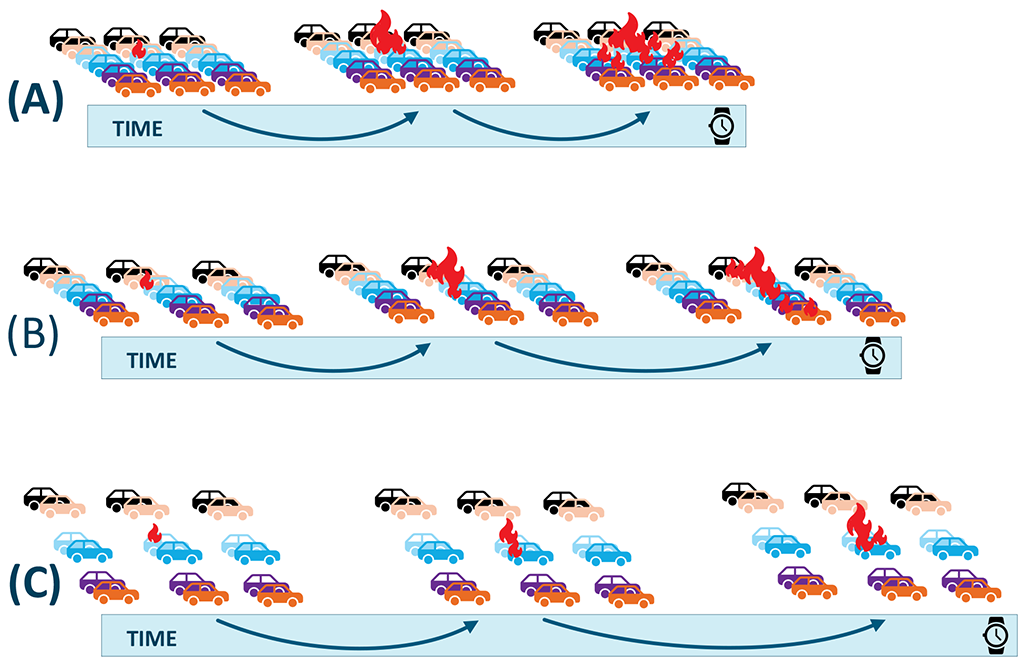
Parking Layouts and Garage Design Matter
Vehicle spacing is a key factor in fire propagation risk. While no formal industry standard exists for vehicle spacing in fleet fire safety, EPRI emphasizes that increasing the distance between vehicles can reduce the likelihood of fire spread and give first responders more time to arrive.
Multilevel parking garages present additional challenges. Enclosed or partially enclosed spaces can trap heat and smoke, complicating firefighting efforts and evacuation. Fleet operators are encouraged to place EV parking and charging in locations with good access for responders and proximity to water supplies, and to verify compliance with applicable electrical and fire safety codes.
Insurance providers may also impose additional requirements related to charging installations and parking layouts, making early engagement advisable.
Prevention, Response, and Business Continuity
Pre incident planning with local fire departments is one of the most important steps fleet managers can take. Fire departments can assist with site assessments, access routes, utility shutoffs, evacuation procedures, and alignment of emergency response plans with local capabilities.
EPRI’s research describes both offensive and defensive firefighting approaches for EV fires. Offensive approaches focus on applying large volumes of water to cool batteries and suppress flames. In contrast, defensive approaches may prioritize containment and monitoring to reduce environmental impact and re ignition risk. The chosen strategy depends on site conditions, your local fire department’s equipment and training, proximity to structures, and life safety considerations.
Because EV fires can disrupt operations for extended periods, fleet managers are also encouraged to plan for business continuity. Alternate access routes, secondary parking locations, and contingency plans can help limit downtime following an incident.
Preparing for a Safe Transition
As fleets transition to electric vehicles, fire safety planning must evolve alongside vehicle technology. While EVs introduce new hazards, many core fleet principles remain the same: preparedness, training, coordination with first responders, and thoughtful facility design.
By understanding how EV fires differ, recognizing the role of charging infrastructure, and implementing best practices across operations and storage, fleet managers can reduce risk and support a safe, resilient move toward electrified transportation.
Learn More
- EPRI White Paper: Fire Safety Considerations for Electric Vehicles and Charging Stations for Fleet Managers
Microsoft Copilot was used to generate a draft of this article from an EPRI publication. AI-generated content was reviewed, edited, and fact-checked by an EPRI expert to ensure accuracy and quality.
Banner image licensed by EPRI from Adobe Stock