

To adequately grasp the expertise and extraordinary focus that analysts inspecting nuclear reactor vessel head penetrations must have, it’s necessary first to visualize miles of data. Robust inspections of reactor vessel head penetrations are a key part of ensuring the safety of pressurized water reactors (PWRs). Reactor vessel head penetrations are small openings in the thick steel lid at the top of a nuclear reactor that allow long metal tubes to enter the reactor, enabling operators to control the nuclear reaction.
These penetrations must be rigorously inspected because they are exposed to intense heat and pressure. Traditional non-destructive evaluation (NDE) inspection of the penetrations involves ultrasonic testing (UT), where high-frequency sound waves are used to look for cracks and defects. To do that, a probe is moved over the inside surface of the reactor vessel head penetrations to capture ultrasonic data—basically snapshots of sound waves bouncing off the metal.
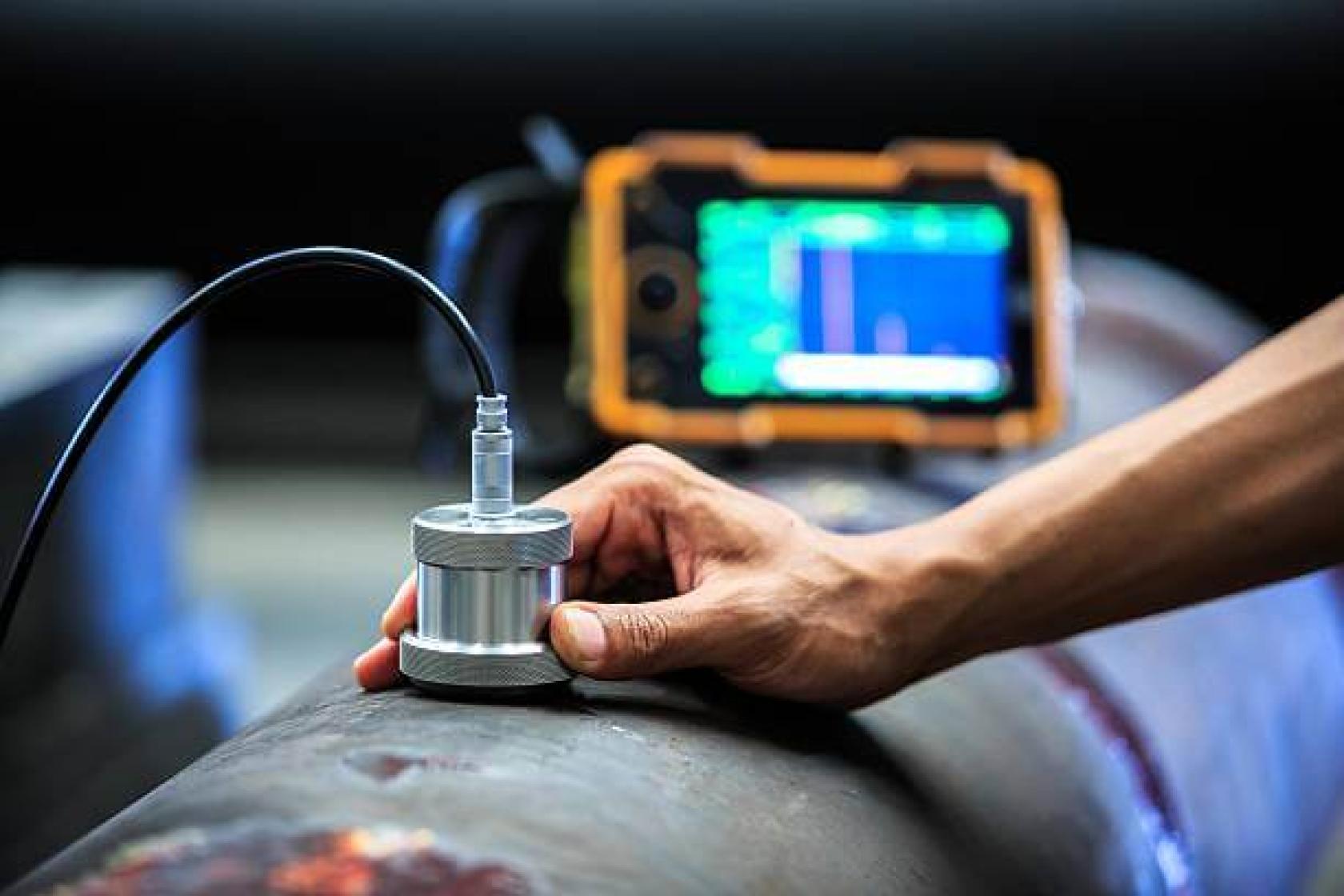
That’s when the work of the UT analyst begins. It is their job to review the equivalent of four miles of UT data for the 60 to 80 penetrations in each reactor vessel head. Their task: find the tiniest indication of abnormalities. The overwhelming majority of data an analyst will review has no signs of problems. Indications that warrant closer inspection will be found on just one or two lines of data, comprising about a quarter inch over four miles of normal-looking information.
The reasons why the work of a UT analyst is so challenging are not surprising. While analysts are skilled and experienced, they are still human, and their inspection work needs to be completed while a reactor is offline for maintenance, which adds time pressure to their task. “There’s going to be fatigue,” said Thiago Seuaciuc-Osorio, an EPRI Senior Technical Leader. “They have to work in shifts 24 hours around the clock and go through these miles of data, one click at a time. It makes a difference if they’re at the start or the end of the shift because it is hard for anyone to maintain focus for hours.”
A Job for AI?
EPRI’s Materials Reliability Program (MRP) released strategies aimed at mitigating inspection errors. One of the mitigation strategies was to reduce analyst distractions. Another was for analysts to review all the data for a single penetration in one sitting, mitigating distractions and reducing fatigue. These include suggesting that analysts review all the data for a single penetration in one sitting—a process that a report conducted for the Nuclear Regulatory Commission (NRC) by the Pacific Northwest National Laboratory (PNNL) estimates takes about 90 minutes. Although potentially helpful, the sheer volume of information analysts must review also makes these inspections an ideal candidate for assistance from artificial intelligence (AI).

Indeed, the basic idea is that AI can focus human expertise on the data where it is most needed by taking on the monotonous, time-consuming, and low-value work of scanning oceans of data to pinpoint the anomalies that merit closer attention. “Most of the data doesn’t have anything of concern. Faults are rare,” Seuaciuc-Osorio said. “AI can do the easy job and leave the hard work for the inspectors.”
Part of a Larger Effort to Modernize NDE with AI
EPRI’s work on reactor vessel head penetrations is just one piece of a broader, multi-year effort to apply AI to several high-value NDE applications across the nuclear fleet. While EPRI’s research initiatives vary—also focusing on ultrasonic examinations of dissimilar metal welds, core shrouds, and core barrels—what they all share is an inspection process that involves time-consuming and technically demanding reviews of large amounts of data.
Although each inspection method has its own unique demands and challenges, the overall approach is similar—that is, to use AI to conduct an initial review, winnowing large volumes of data into more manageable subsets. The AI can then guide analysts to scrutinize the most relevant data. For core shroud and core barrel inspections, EPRI is also pursuing automated length-sizing capabilities, allowing analysts to spend more time interpreting flaws rather than characterizing them.
In addition, separate EPRI research is exploring how to support manual UT, a fundamentally different process because it generates no encoded record. And beyond ultrasonics, EPRI is developing AI to assist with visual inspections of reactor internals, using video data to highlight areas of potential interest.
Taken together, these efforts seek to standardize analysis and maintain high inspection reliability even as experienced analysts retire and the demands on NDE programs increase. Importantly, the work also aims to direct the cognitive efforts of analysts toward the most mentally demanding tasks. “Humans are really good at the cognitive part—much better than AI,” Seuaciuc-Osorio said. “AI reduces the cognitive load, but more on the easy, monotonous part, not the difficult part that really requires human expertise.”
How AI Assists with Upper Head Penetration Inspections
EPRI’s work on reactor vessel upper head penetrations is the first of these initiatives to reach full field deployment.
The AI model’s job is to identify potential flaws or aberrations for the analyst to examine. To do that, the model needs to be trained on data that helps identify potential anomalies. Put more simply, the model is a finely tuned filter designed to detect even the smallest signs of irregularities. To do that, the model was trained using field data from canceled or decommissioned components, which were supplemented with virtual flaw augmentation to expand the diversity of examples.
By having AI perform an initial review of the data, the model significantly reduces the amount of data that analysts must evaluate. During field trials, Seuaciuc-Osorio said the flag rate averaged around 3 percent of total data, even with the model tuned conservatively toward detection.
Importantly, the AI is not a self-learning system once deployed. After the model is qualified, the model is “frozen,” meaning it provides the same output for the same data indefinitely. That stability is essential for regulatory compliance. As Seuaciuc-Osorio noted, if the model continued to evolve in the field, “qualification would be impossible,” because the approved version would no longer match what is used in practice.
A Milestone Deployment in Sweden
EPRI worked with U.S. utilities to validate and improve the technology—well in advance of the recent focus on AI. For example, both Constellation Energy and Tennessee Valley Authority both received 2024 Technology Transfer Awards for their collaboration with EPRI to test AI’s ability to support inspections. Through field trials, which were conducted separately from formal inspections, analysts experimented with the tool, provided feedback, and helped shape updates to enhance its usability and workflow.
These field trials helped confirm the tool’s reliability. They paved the way for a landmark deployment in 2025 at two units of Vattenfall’s Ringhals plant in Sweden—an effort that both validated the technology and established an important regulatory precedent.
Sweden uses a formal process for approving new inspection methods, including those that use AI. As part of that process, the method must pass two steps: an open qualification, where inspectors test the approach on practice pieces they’re allowed to study ahead of time, and a blind qualification, where they must find flaws in similar pieces without knowing where the flaws are. These practice pieces—called mockups—are specially designed sections of metal that contain known flaws, allowing qualification bodies to evaluate whether an inspection method is effective. Because the Ringhals plant didn’t have its own mockups, EPRI shipped over the U.S. mockups created through its Materials Reliability Program. After reviewing the technical details, the Swedish qualification body evaluated the mockups and approved them for use in the qualification process.
The Swedish utility made a bold choice: they intended to use AI as a primary examination tool, meaning the AI would screen all data before analysts viewed it. “We thought this was kind of an aggressive first step,” said Leif Esp, an EPRI Program manager who worked with Vattenfall to integrate AI into its inspection process. However, Vattenfall was motivated by a clear goal—to reduce outage time by dramatically decreasing the number of hours analysts spent manually reviewing encoded UT datasets.
During qualification, the AI first had to prove it could identify every known flaw in the blind test samples before analysts were allowed to review any data. Once it demonstrated 100% detection, the flagged areas were handed over to the human examiners, who had access to the entire dataset, including the areas that had been flagged. The engineers then completed their portion of the test. According to Esp, the results underscored the tool’s reliability and the potential effectiveness of combining AI and human oversight. “Everybody who took the test ended up passing with the AI,” Esp said.
Vattenfall then used the system in two consecutive outages at Ringhals. Initially, analysts manually double-checked all data because they didn’t trust the AI model’s accuracy. “The analysts reviewed 100 percent of the data,” Esp said.
But within several days, the analysts were confident the AI wasn’t missing anything. By the second outage, the utility fully leveraged the AI from the start. According to Esp, the AI-aided inspection reduced the overall examination time and improved the efficiency of the examination process for the UT analysts.
The accomplishment was also historic. The Ringhals deployment was the first example of any AI application in a nuclear power plant that required regulatory approval. The use of AI was not only a technical success, but it also demonstrated the feasibility of formal qualification pathways for future AI-enabled NDE tools.
Looking Ahead: Expanding AI’s Role in NDE
EPRI’s next steps build directly on what was learned at Ringhals and through earlier U.S. trials. Work continues to enhance AI models for dissimilar metal welds and core shroud inspections, including the collection of additional field data. Prototypes for manual UT assistance are planned for demonstration next year, and utilities are beginning to examine how AI-supported visual inspections may improve consistency and reduce review time. International collaboration is also increasing, with European partners expressing interest in adapting qualification approaches used in Sweden.
Regulators, meanwhile, are signaling their support for the current use cases, which keep analysts in the loop. Future visions of fully automated analysis, where there is no human review, would require substantial additional evidence and regulatory changes. But for now, the focus remains on tools that augment analysts without replacing their judgment.
For Seuaciuc-Osorio, the ultimate goal is straightforward: ensure inspections remain reliable, efficient, and repeatable across the global fleet. The early results suggest that AI can reduce fatigue, sharpen human focus, and strengthen the effectiveness of systems that protect nuclear plant safety. “The technology does not eliminate the need for analyst expertise. It allows it to be focused where it is needed most,” he said. With each successful deployment, the industry gains a clearer understanding of how AI can become a trusted partner in ensuring nuclear safety far into the future.
EPRI Technical Experts:
Thiago Osorio, Leif Esp
For more information, contact techexpert@eprijournal.com.