


EPRI analyzes real-world projects to understand why data centers are embraced or rejected by communities
Data centers are at the center of international socio-political and economic discussions at the community, regional, and national levels. Many of those discussions focus on opposition to data center development in residential areas. For example, a recent poll of over 2,000 American voters, conducted by Embold Research for Heatmap Pro, found that 75 percent of respondents oppose building a new data center near where they live. According to an analysis by the advisory company Relae, community opposition has led to 46 artificial intelligence (AI) data centers totaling $170 billion being blocked, stalled, or withdrawn between January 2024 and May 2026.
Public attitudes toward data centers are varied and nuanced across Europe. For example, a recent Irish Times/Ipsos B&A poll found that 61 percent of respondents supported a temporary moratorium on data center construction. In contrast, a separate survey found that 66 percent of Germans said they would view a new data center in their community positively. Whether positive, negative, or indifferent, one thing has become clear: public perceptions of proposed data centers significantly affect whether projects move forward.
Community-Centered Data Center Development
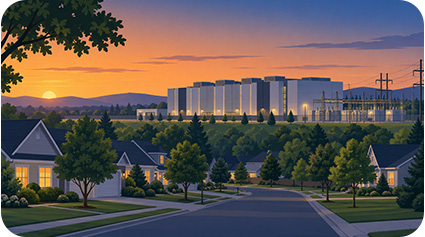
As a result, data center developers, hyperscalers, utilities, regulators, and policymakers are under pressure to better understand the drivers of community support and opposition and to learn lessons from community engagement initiatives that worked well and those that did not. The recent EPRI report, Partnering for Progress: Understanding Community-Centered Data Center Development, aims to support knowledge transfer to enable community benefits from data center development.
“We are hearing so much about community acceptance and opposition to large infrastructure projects, data centers specifically, and it seems to be a universal bottleneck in infrastructure,” said Gabriella Siegfried, an EPRI project manager who manages research projects related to community initiatives, affordability, customer behavior, and social impact. “There’s also a huge risk in terms of building or breaking the bonds of trust with local residents in communities.” With many global data center projects in the development, construction, or operational stages, Siegfried and her colleagues had to winnow the list to find lessons that would be instructive for communities, developers, utilities, hyperscalers, policymakers, and others.
The real-world examples featured in the report were selected based on a set of criteria. There had to be sufficient public information about each project, including independent sources able to establish basic facts. Whenever possible, EPRI relied on government documents, such as zoning ordinances and national policy statements, as well as news coverage. Importantly, the researchers attempted to quantify investments made in communities by project developers and owners as well as the costs of canceled and delayed projects. From the outset, EPRI sought to focus on both successful and failed projects, recognizing that each provides valuable insights.
Why it Matters to Utilities
“In the social science work I do, I interview 20 to 30 member companies a year to get a sense of their community-based priorities,” Siegfried said. “Data centers are at the top for almost everyone I interview.” In some instances, it’s a top priority because utilities are developing their integrated resource plans (IRPs) and need to be confident they can serve large loads, like data centers. It also matters to utilities when data center projects are canceled or delayed. “In such cases, the utility has an opportunity to engage with the community, address concerns, and strengthen trust,” Siegfried said.
Data centers also feature prominently in debates about electricity affordability and utility grid investments. At town halls and in political advertising, data centers are frequently blamed as the main driver of rising utility bills, whether or not evidence supports that sentiment (EPRI research says it depends, and the opposite is possible in certain scenarios). “It’s really difficult to change sentiment once it’s embedded,” Siegfried said. “For example, community members may believe the utility is upgrading or expanding a substation to help data center development, and customers may attribute increases in their bill to such projects, even if inaccurate or misinformed.”
Drivers of Community Opposition
Affordability is one of eight drivers of community opposition to data centers identified by Siegfried and her colleagues. Others include the use of water for cooling, noise from operating facilities and construction traffic, emissions, and land use impacts. The report found that nondisclosure agreements (NDAs), redacted documents, and late or limited engagement erode community trust and can amplify resistance. Across the examples, stalled projects tended to share a trust deficit and engagement that came too late.
For example, the report highlights a proposed $1 billion data center in St. Charles, Missouri, known as Project Cumulus. According to local news coverage, the developer sought a permit to store about one million gallons of diesel fuel in 150 tanks, partly over the city’s wellhead protection district, which safeguards the groundwater feeding the city’s water supply wells. Residents objected to both the risk of groundwater contamination and the secrecy surrounding the project, whose end user was never disclosed. By the time a town hall was held in August 2025, the project had been in the works for more than a year. The mayor said that transparency had been a problem throughout, and hundreds of residents turned out, many to express their opposition. The project was withdrawn later that month, and the city council imposed a one-year moratorium on new data center applications.
A very different approach to community engagement comes from outside the data center industry. For years, planning rules made it nearly impossible to build new onshore wind projects in England. In 2022, Octopus Energy launched Winder, a matchmaking platform that starts with communities that want wind turbines and pairs them with available land, grid capacity, and strong wind resources. Households near Octopus turbines can receive discounted electricity through the company’s “Fan Club” tariff, and demand for that benefit helped drive the requests.
Drawing on more than 15,000 community requests, Winder has identified up to six gigawatts of potential onshore wind capacity, according to the company. Making community support the first step rather than a problem to be managed at the end is designed to speed development and reduce conflict.
What Builds Trust
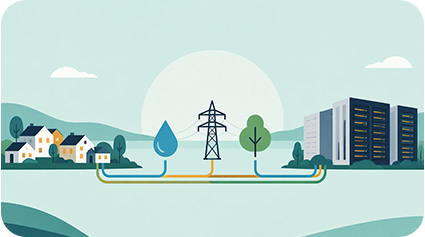
The report offers several ways data center developers can earn community trust. One is the importance of connecting any promise of community benefit to concrete, specific, and measurable outcomes. Or, to put it more plainly, community trust develops when developers do what they say they will, and there are transparent, accepted methods to prove it.
More specifically, one common community concern is that data centers create many short-term construction jobs but little long-term employment. Addressing that skepticism also comes down to specific, measurable outcomes, such as directing community investments toward workforce development programs that local leaders and residents identify as important. The report also emphasizes the value of developing strategies and metrics for mitigating the environmental impact of data centers, including reducing water use, managing emissions, and pairing data centers with clean energy.
For Siegfried, underneath these specific strategies is something more elemental. “If you plan to operate in a community for 100 years, it behooves you to be a good business partner, a good neighbor,” she said, noting that how and when developers initially engage sets the tone. “What matters to communities is: showing up, being there in person, consistently talking to community members, and incorporating their feedback. You can’t deny the value of that, and it’s hard to put a dollar amount on its importance.”
A Lot Still to Learn
This report is not the end of EPRI’s work on identifying what constitutes collaborative relationships between data center developers and owners, utilities, and communities. Siegfried acknowledges that it’s a rapidly evolving topic, with moratoriums that pause data center development nationwide. Besides continuing to draw lessons from international examples, Siegfried plans to communicate EPRI research findings on topics relevant to data centers, such as water usage, for public education.
Siegfried also sees the benefit of EPRI playing its traditional role as a convener bringing groups together and performing on-the-ground research with stakeholders. “If we were able to do field research and talk to communities, we may be able to provide some connective tissue and bridge building between these diverse stakeholders,” she said.
EPRI Technical Experts:
Gabriella Siegfried
For more information, contact techexpert@eprijournal.com.