Tags: Nondestructive evaluation, nuclear inspection, Small modular reactors


Nuclear power is playing an increasingly critical role in meeting the world’s quickly growing demand for electricity. According to the International Energy Agency (IEA), global nuclear power plant generation reached a record high in 2025, with output increasing by 1.2 percent from 2024, thanks to new units coming online worldwide and restarts at Japanese power plants. A new report from Bloomberg New Energy Finance (BNEF) found that 76 large reactors are under construction globally, and forecasts that nuclear energy capacity will increase 44 percent by 2036 compared to 2025 levels.
At the same time, interest and investment in new nuclear technologies, such as small modular reactors (SMRs), is accelerating. IEA has pointed to surging data center electricity demand as one driver behind faster SMR commercialization. For example, the pipeline of conditional offtake agreements between tech companies and SMR projects grew from 25 gigawatts at the end of 2024 to 45 gigawatts by April 2026, according to the agency’s reporting.
This growth is unfolding on two fronts at once. Utilities are restarting plants that had stopped generating electricity years ago and extending the operating licenses of reactors approaching the end of their original terms. At the same time, developers are racing to bring entirely new reactor designs online. Both fronts depend on the same underlying requirement: proving that the components inside these reactors, old and new alike, can be reliably inspected for safety.
That is where EPRI’s performance demonstration (PD) facility in Charlotte, North Carolina, comes in. For more than three decades, the lab has been where the nuclear industry proves its inspectors and inspection techniques actually work, not just on paper, but in practice. As the industry expands, that role is only becoming more central.
Built to Solve a Problem
Carl Latiolais has led much of that work. When he joined EPRI on Valentine’s Day 1994, the use of non-destructive evaluation (NDE) inspection techniques in the nuclear industry faced a crisis. NDE describes several methods for inspecting components without damaging them. The primary method is ultrasonic testing (UT), which uses high-frequency sound waves to detect cracks and other defects in reactor pressure vessels, dissimilar metal welds, piping, and other critical components in both pressurized water reactors (PWRs) and boiling water reactors (BWRs).
But the inspections meant to keep those plants safe were themselves in trouble. “During the 1980s, there were a lot of material issues with detecting intergranular stress corrosion cracking in piping systems, mainly in boiling water reactors,” said Latiolais, who received the EPRI 2025 Chauncey Awards’ Lifetime Achievement Award for his NDE leadership and work as EPRI’s PD Lead.
Stress corrosion cracking had a serious impact on the industry because it raised the possibility of reactor coolant leaks, which also elevated safety concerns if cracks grew undetected. The risk of cracking increased inspection and maintenance requirements, leading to higher outage costs and reduced plant availability. “It got to a level where the regulators were about to force shutdowns of these plants until they either repaired or replaced the components. They had lost a lot of trust in NDE.”
An Industry Response
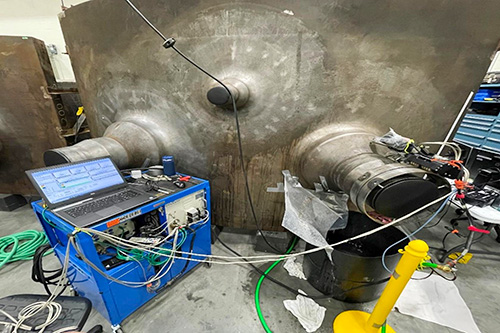
A series of actions followed to rebuild trust in NDE, which ultimately included the creation of EPRI’s PD testing facility in Charlotte. After it became clear that NDE was not adequately detecting and characterizing flaws that led to leaks, EPRI joined with the Nuclear Regulatory Commission (NRC) and the Boiling Water Reactor Owners Group (BWROG) to establish the Tri-Party Agreement, which established a UT testing and training program. Later, the NRC decided more was needed and that the qualification rules needed to be formalized so they would apply to the entire fleet, not just the BWRs.
After the NRC proposed qualification requirements, the industry formed a committee to develop what eventually became the ASME Appendix VIII requirements, which required that inspectors, procedures, and equipment demonstrate they could reliably find and size flaws by testing against samples manufactured to replicate real, albeit defective, components. ASME published Appendix VIII in 1989, and utilities were given until 1997 to comply fully.
U.S. utilities needed one program to meet that requirement efficiently across the industry, and they selected EPRI to administer it. In 1991, member utilities funded EPRI’s Performance Demonstration Initiative, and the work of developing a program capable of confidently qualifying NDE inspectors and processes began. Latiolais was hired in 1994 to run the piping portion, the largest piece of the effort, and the first qualifications began that same year, with reactor pressure vessel testing following in early 1995.
A new challenge emerged in the 2000s, with the discovery of pressurized water stress corrosion cracking (PWSCC) in the PWR fleet. The cracking was found in nickel-based alloys, known as Alloy 600, which was used extensively in the construction of both PWR and BWR units. Routine inspections early in the decade revealed failures in a reactor upper head penetration and a main loop dissimilar weld at two different operating plants in the PWR fleet. The widespread use of Alloy 600 called into question the continued operations of the PWR fleet.
In response, regulators ordered expedited inspections of components with the nickel-based alloys. But it soon became clear that research was needed to address significant limitations in the inspection technology. EPRI took the lead by supplementing the existing PD program infrastructure with new mock-ups suitable for qualifying both techniques for examining existing welds and for techniques used to mitigate and repair degradation, such as weld overlays. For much of the 2000s, EPRI’s PD worked to develop and qualify a variety of examination techniques capable of reliably detecting and sizing flaws. The work provided regulators with reasonable assurance that NDE could be used as a tool to effectively manage the threat to the PWR fleet.
“Building Flaws”
Latiolais recalls the early years of necessary improvisation. Testing was initially scattered across borrowed lab space in a shared EPRI building, with staff monitoring each room individually to preserve the blind conditions the tests depend on. In 2011, the program moved into a dedicated facility, a former floppy disk manufacturing plant that was retrofitted to consolidate testing, sample storage, and staff offices into one secure, controlled space.
Building the samples that allow for rigorous blind tests was its own technical challenge. Each mockup needed flaws of precisely known size and location, engineered to produce realistic ultrasonic responses without the kind of defects that would make a test unreliable. The very nature of that work, creating component mockups that are intentionally defective, can seem counterintuitive. “We’re building flaws,” Latiolais said. “The quality assurance people come in and say, ‘I can’t get my head around this.’ I said, well, look, but these samples are not going to get installed in the plant.”
Today, that facility houses more than 700 component mockups and has conducted over[LT1.1] 20,000 qualifications for more than 1,000 personnel and 100 procedures, making it, by EPRI’s account, the largest and most influential program of its kind in the world.
“A lot of countries follow some or all aspects of the U.S. codes. They have their own regulators, but their regulations often mirror what the U.S. is doing,” Latiolais said. “If the U.S. regulators require something, it’s generally required in some form or fashion elsewhere.”
A New Kind of Examination for a New Era
EPRI’s PD program is evolving to continue supporting a growing and changing nuclear industry. One way is to help develop artificial intelligence (AI) to support NDE inspectors.
Nuclear inspection has always required a lot of inspectors. Inspections require the skills and experience to analyze ultrasonic data for anomalies that may indicate a flawed component. Training and sharp judgment are necessary, but not enough on their own. Inspectors also need to remain focused for extended periods as they review large volumes of mostly normal data.
Federal researchers have identified fatigue and distraction as recurring contributors to missed flaws in reactor inspections. Now, EPRI is working with vendors and utilities to bring AI into the examination process, not to replace the inspector’s judgment, but to sustain the vigilance that judgment depends on.
The results from early deployments are encouraging. In one field trial reviewing reactor vessel head inspection data, EPRI found that AI-assisted screening could flag the small fraction of data that warranted a closer look. This reduced the volume of data an inspector needed to review from roughly 7 kilometers to about 140 meters, without sacrificing the quality of a fully manual review. The technology is now qualified for use at Sweden’s Ringhals 3 and 4 reactors. It is also supporting inspection oversight at three U.S. plants, work that regulators, including the NRC, have observed directly in the field.
The challenge isn’t just proving that AI-assisted inspection has value and works. It’s proving, rigorously and repeatedly, that it does, and building a process to requalify it whenever the algorithm changes. That work is a priority for Latiolais and his team and requires close coordination with the regulators and the organizations responsible for developing codes.
Another priority is developing NDE inspections of advanced reactor designs, including SMRs. Developers of SMRs and other next-generation reactors are working with EPRI to determine how their components can be inspected and monitored. Traditional ultrasonic techniques may not apply directly, and EPRI is now helping to write entirely new sections of the ASME code to define what qualification will look like. Separately, the lab continues to push the underlying measurement technology, developing faster, higher-resolution ultrasonic techniques that promise to reshape inspection over the next decade.
After thirty years spent building an inspection qualification process that works so well the industry barely notices it, Latiolais is ready for others to write PD’s next chapter, not that he plans on going anywhere soon. “Eventually, it will be handoff time,” he said.
What he’s handing off is not just a modernized, expansive facility unmatched around the world, but a team built to keep asking the same question he’s asked since 1994: can an inspector, a technique, or now an algorithm, prove that it is consistently reliable and trustworthy? It’s a question that will only grow in importance as nuclear power plays an increasingly important role in meeting the world’s energy needs.
EPRI Technical Expert:
Carl Latiolais
For more information, contact techexpert@eprijournal.com.
Banner image was created by EPRI Using Microsoft Copilot.